Monday, June 23, 2008

No Food in Drought-Hit Ethiopian Regions, UN Official Says


22 June 2008

Hunger in Ethiopia now spreading to adults

The United Nations is sounding another alarm about severe food shortages in Ethiopia, where tens of thousands of children are facing starvation. VOA's Peter Heinlein in Addis Ababa reports the U.N. children's agency UNICEF is appealing for nearly $50 million in emergency aid for the hardest-hit areas, where food stocks are depleted and the next harvest is months away.

A malnourished child waits for food aid in the southern Ethiopian town of Shashamane, 06 Jun 2008
A senior U.N. children's agency official visiting drought-ravaged areas of southern Ethiopia during the past week found families with no food, not enough money to buy any, and no hope of replenishing supplies until at least late September.

UNICEF Deputy Director Hilde Johnson says everywhere she went, government officials and aid workers gave the same assessment.

"A clear message was conveyed to us from all of them: There is no food," said Hilde Johnson. "The assistance needs to be taken to scale, and it has to happen urgently. There was absolutely no inconsistency. That was the message from everyone."

The UNICEF official says during her four-day visit, she had positive meetings with Prime Minister Meles Zenawi and other senior leaders, some of whom have accused aid agencies of exaggerating the food shortages for fund-raising purposes.

Hilde Johnson (undated photo)
UNICEF's Johnson says in her talks, all government officials agreed the food shortages are serious and getting worse. She told reporters the ministers expressed hope the crisis would ease later this year if conditions improve. But she says there are many 'ifs'.

"The government do think they will be able to curb in the sense the situation later, meaning August, September, If the rains come in accordance with normal, If there is an adequate vegetable harvesting, If other complementary measures are kicking in, plus If the supplies they are buying externally to come into the market, plus aid bilaterally they are negotiating comes in," said Johnson. "So there is a clear "if", and that is no secret."

U.N. humanitarian agencies say it is impossible to know how widespread the food shortages are in a country where record-keeping is poor.

"It is very very difficult for us to say how many children are dying," she said. "From our visit in the hot spot areas of Kambala, we were told by health extension officers that children were dying in the villages now, and that for quite many it was too late. There is no doubt there is a risk of children dying in numbers in the hot spots."

Ethiopian officials have repeatedly emphasized that this drought is not a famine, such as the one in the mid 1980s that killed an estimated one million people.

Ethiopia's disaster preparedness agency this month more than doubled its estimate of the number of people needing food assistance from 2.2 million to 4.6 million.

Disaster preparedness agency chief Simon Mechale is predicting worse conditions in July. He recently appealed to donor nations for $325 million worth of emergency food aid to make up an expected shortfall of 390,000 metric tons until the next harvest comes in.

Related news

Famine-hit Ethiopia ups army budget

Woyanne’s Bankrupt Policy of Divide and Rule

Hunger in Ethiopia now spreading to adults


Saturday, June 14, 2008

Ethiopian children face starvation

By Gavin Hewitt
BBC News, Ethiopia

Ethiopian boy Tareknge and his mother
More than 126,000 Ethiopian children could be affected by malnutrition
A woman walks slowly down a track between eucalyptus trees. On her back is a boy, his head emaciated and swollen.

She is just one of several hundred mothers who have walked for hours to find help. But her son, whose name is Tareknge, is starving.

His is the face of hunger and the face of a crisis that is developing in Ethiopia's south-west.

Later, we wanted to find out what had happened to Tareknge, and what it could tell us about the growing food crisis. We returned to the village of Garogoto and showed people a picture of the boy and his mother. Very soon someone told us the name of their hamlet.

We drove for half an hour along narrow, mud-packed roads past traditional thatched-roofed houses. Here the children run towards a car - particularly one with foreigners inside. They hoped we would give them some food.

Many of the children were ragged. They had flies around their mouths and eyes. Some had distended stomachs.

The grain has never been so expensive - it has never reached this level before
Idris Mohammed, trader

We arrived at the hamlet of Dache Goffara. We were surprised to find Tareknge had returned home. His father invited us inside.

Tareknge was sitting beside the coals of a small fire. He was weak and listless.

His father said that they did not have the money to take him to hospital, so his mother brought him home. At the feeding centre, they gave the mother a few high-nutrition biscuits.

I could not tell the age of Lekmo, the father. He sat between the grey smoke of the fire and the shaft of sunlight through the door. Lekmo had no answers - he was resigned to what he feared.

"We used to give Tareknge some corn bread and sweet potato," he told us, "but we no longer have any of these things. We have nothing at the home at the moment. Nothing."

Lifeline

Outside his house was the rest of the village. Most of the children were malnourished.

It was a strange sight. The houses were surrounded by green stalks of corn, but the harvest was still three to four months away. A drought and a failed crop had left them with almost nothing.

There were the tall fronds of what they call "false banana" - a drought-resistant plant, for many a lifeline.

There are two ways of eating false banana. One is cooking the roots, while the other is taking parts of the trunk and burying it, allowing it to decompose before eating it - but it has to stay buried for three months, and even then it is of low nutritional value.

Villagers in Dache Goffara
Late rains and the high cost of food mean millions will need food aid

The villagers watched us, curious as to what our visit would mean for them. Through an interpreter I asked them who was eating less than one meal a day. Every hand went up.

And then one hand became two, out-stretched, pleading for help.

They knew they had to scrape by for two to three months.

If there is no emergency food aid, tens of thousands of children will die. The under-fives are the most vulnerable. A few have died already. Their immune systems are so undermined that a small setback can be fatal.

About an hour by car is the larger town of Boddetti. The market bustled. There was food here. Small piles of maize, barley, teff, lentils and beans.

The prices had doubled in just five months. The traders struggled to make a sale. The people could not afford the price.

At the grain market in Addis Ababa, the capital, some said the price of teff, their most important grain, had trebled.

"The grain has never been so expensive," said Idris Mohammed, one of the traders. "It has never reached this level before."

And that is Ethiopia's problem. As many as 4.5 million people are judged to need critical, emergency assistance. Not only are food prices soaring but there is not enough food in the country.

The choice is stark. Without help, thousands of children will not survive the next few months, but as we travelled through the villages there was no sign, as yet, of the kind of operation that would save lives.

The children may be poor but, with help, most of them can survive.

Related News

Red Cross helps with Ethiopian food crisis

Oromo Youth Leadership Conference (OYLC) 2008

13 06 2008

For two consecutive summers starting from 2006, Oromo youth from around the world have been gathering with fellow young Oromo women and men to build their leadership skills and share their Oromumma through the Oromo Youth Leadership Conference (OYLC), which was initiated by two visionary young Oromo men in 2006 to create a network among Oromo youth from all across the globe. About 60 Oromo youth attended the 2007 leadership conference held in Minneapolis, MN, taking part in rigorous, challenging, educational, as well as entertaining seminar. The participants discussed various issues related to the Oromo people, guided by prominent Oromo scholars and elders that were invited to educate the youth about their particular area of expertise. The issues discussed included the history and language of the Oromo nation, religion, region and gender issues in the community, the state of Oromo youth in exile, and the then current state of Oromia. The conference was concluded by drafting and finalizing a constitution that guides the umbrella organization (International Oromo Youth Association – IOYA).

The preparation for the third Oromo Youth Leadership Conference is underway. It will be held in the state of Minnesota from July 21 – July 25 under the theme “Building the future one youth at a time”. This year’s conference will again be very crucial because it comes in a time where the persecution of the Oromo people is being taken to a new level, as the oppressing regime changes its strategy to undermine the voice of the Oromo people by instigating conflict with neighboring tribes while trying to stay below the radar of the international community. This will be where ideas on how to move forward and the actions that need to be taken will greatly be discussed.

About 75 Oromo youth from all parts of the world are expected to take part in this three day leadership conference this year. A number of Oromo and non-Oromo speakers, both from Oromia and from around the world will be invited to speak on various topics chosen for this year’s conference.

The topics of this year’s conference include:

Leadership Training
Building individual leadership skills
Applying leadership skills
Health Crisis Facing Oromo Youth in Diaspora
The Place of Oromo Women in The Struggle
“The Forgotten Queens”
Region and Religion
Religion and Nationalism: In Harmony or Discord?
The roots of Oromo People
The Oromo people: 19th century – present
Promoting Art in the Oromo community
Art workshops
Current issues in Oromia
IOYA/OYLC Logistics
This year’s conference is being organized in a unique way by utilizing the inputs and lessons acquired from the previous two conferences. It is also uniquely structured so that all participants will get a chance to practice and develop individual and community leadership skills to achieve personal growth and create a true friendship with their peers. The setting and coordination of the conference is designed to create a safe and secure venue for the participants to openly discuss, debate, question, critic and communicate. The organizers of this conference are committed to make sure that all of our participants make the best out of their time with us.The OYLC Coordinators and the IOYA executive board are working tirelessly to ensure the success of this year’s conference. We ask all Oromos and friends of Oromo people to support our efforts morally, logistically and financially. We also call on all parents, guardians and family members to encourage their children to attend this conference.

For questions, suggestions or comments please contact OYLC coordinators at

oylc2008@gmail.com
For registration and more information about the conference please visit our website http://www.ioyn.org/oylc/register.html

Thank youOYLC Executive Coordinator

Wayane's military has destroyed eastern region of Ogaden Villages.

Satellite Images Show Destruction of Ogaden Villages

Posted on: Friday, 13 June 2008, 13:20 CDT

Images obtained from satellites confirm reports that Ethiopia’s military has destroyed several towns and villages in the nation’s arid, rocky eastern region of Ogaden. The images were disclosed Thursday as part of a report by the American Association for the Advancement of Science (AAAS), and provide evidence of burning and other destruction in the area.

In the past the AAAS has used satellite images to support claims of widespread abuses in Myanmar, Burma, Zimbabwe, Chad and the Darfur region of Sudan.

The commercially available images show eight sites in the remote Ogaden region bordering Somalia with clear signs of burning and other destruction. They corroborate a separate report by the U.S.-based Human Rights Watch, also released Thursday, which includes eyewitness testimony of attacks on thousands of ethnic-Somali Muslims, the AAAS said.

"The Ethiopian authorities frequently dismiss human rights reports, saying that the witnesses we interviewed are liars and rebel supporters," Peter Bouckaert, emergencies director at Human Rights Watch, said in a statement about the matter.

"But it will be much more difficult for them to dismiss the evidence presented in the satellite images, as images like that don't lie.”

Ethiopia is a major United States ally in the region. Reports indicate the nation launched its latest attack after the Ogaden National Liberation Front killed more than 70 people during an attack on a Chinese-run oil field in April 2007.

But authorities with the Ethiopian government in Addis Ababa have consistently rejected accusations against their counter-insurgency operations, and claim the rebels are abusing the local population Lars Bromley, AAAS project director for the Science and Human Rights Program, said several before and after satellite images of villages identified by Human Right Watch as possible locations of human rights violations were analyzed. The images show that eight locations, mostly in villages and small towns in the Wardheer, Dhagabur and Qorrahey Zones, were either burned or destroyed.

In the town of Labigah, 40 structures identified in a September 2005 image were destroyed in later images obtained in February of this year. The Human Rights Watch report cited an eyewitness who said the Ethiopian army "went into every village and set it on fire."

The accounts are extremely difficult to corroborate because the region "may well be the most isolated place on earth, save perhaps the densest parts of the Congolese or Amazon rain forests," Bromley told Reuters.

The AAAS also said it was nearly impossible to determine precisely what is going on in some of the villages.

"While some towns are considered permanent, they can grow and shrink over the course of a year due to fluctuations in nomadic populations, and many smaller villages will relocate altogether," the report reads.

"To ensure the most accurate results, AAAS for the most part sought to review only permanent towns in the Ogaden, as indicated by their location along a well-defined road and by the presence of square structures with metal-sheet or brick roofing, and most often including a mosque."

---

Image 1: The town of Labigah - 26 September 2005

Image 2
. Images © 2008 DigitalGlobe

Image 2: The town of Labigah - 28 February 2008. Images © 2008 DigitalGlobe

---

On the Net:

American Association for the Advancement of Science

Full AAAS Report

Source: redOrbit Staff and Wire Reports

Related News

Rights group accuses Ethiopian army of abuses

West ignoring Ethiopian war crimes, says rights body


Wednesday, June 11, 2008

Ethiopian commander killed in Somalia

Ethiopian troops are in shock after their leader's death.
Top commander of Ethiopian forces in Somalia has been gunned down by unidentified insurgents in the war-torn country's capital Mogadishu.

The Ethiopian leader was shot in the head by unknown gunmen from a building in the vicinity of the Bakara market in central Mogadishu, a government official told Press TV on Sunday.

The riled Ethiopian troops leveled the building to the ground. Whether any of the insurgents have been killed remains unknown.

Ethiopian troops are said to be in a state of shock and confusion over their leader's death.

The report added that more than 50 Ethiopian soldiers have also been killed in clashes with heavily armed rebels near the Somali Presidential Palace on the same day.

Meanwhile, Mohamed Hassan Haad, the chairman of the Hawiye clan -- the largest and most powerful clan in Somalia -- condemned Sunday's Bakara market attack which left 40 civilians dead and 123 others critically wounded, blaming the Ethiopian troops and Somali government forces for the tragic event.

"Hostility actions from the Ethiopian and the so-called Somali government soldiers are not acceptable," Haad said.

"The Ethiopians have killed uncountable number of civilians and they are the daily problem of Somalis. They are committing genocide and the Hwiye clan cannot accept that," he stressed.

FF/BGH

ONLF Commandos Overrun Ethiopian Defenses in Ogaden Towns


June 10, 2008 Reports reaching our service desk confirm that the Gorgor battalion of the Ogaden National Liberation Front (ONLF) successfully overruns the Ethiopian defenses in the towns of Dhagax-madoow and Dundumo-cadka. Dhagax-madow is in the Jarar province which the Ethiopian military and its associated militias have had a major military garrison. Dundumo-cadka is only kilometers away room the strategic town of Baabili.

Eyewitnesses reported the Gorgor battalion captured both towns and the military garrisons in and around them. Most of the Ethiopian soldiers in these garrisons are reported to either have been killed, captured alive, or are unaccounted for at the time of going to press. It is reported that Ethiopian re-enforcements could not reach both towns since these re-enforcements are said to have been waylaid by ONLF forces, which were strategically placed in all the roads leading to these towns.

Camel herders who were in the area at the time reported that Ethiopian re-enforcements from Dhagax Bur were surprised by a large ONLF force stationed near outskirts of the city. The surprise attack is said to have forced these re-enforcements to return back to Dhagax Bur.

On the Baabili side, ONLF army personnel stationed in the roads leading to Dundumo-cadka ambushed Ethiopian re-enforcements. It is said that these re-enforcements could not successfully reach the town to help out the garrison that was overrun in the town.

There has been no accurate casualty counts in the battles in Dhagax Madoow, and Dundomo-cadka. Locals interviewed by our reporters in these towns indicated that the armies in the garrison overrun by ONLF numbered around 1800 military personnel.

Our reporters in the area reported that the Gorgor battalion is the said battalion that overran the Cobolo oil exploration sites in April 2007. Locals told our reporters in these towns how ecstatic they were in finally seeing the backs of the Ethiopian militias who have been harassing the town folks and looting property for months now.

One of our senior reporters in the area said that the latest successful destruction of main military garrisons belies the recent claims by the Ethiopian prime minister that his army destroyed over 95% of the ONLF army. This senior reporter added that reliable ONLF forces intimated with him that the Gorgor commando operation is only the first of planned ONLF military incursions targeting major Ethiopian military garrisons throughout Ogaden in the coming months.

--Ogaden Online News

Sunday, June 08, 2008

Somalia: Clashes leave at least 10 dead

MOGADISHU, Somalia (CNN) -- Fresh fighting between Ethiopian-backed government forces and Islamic insurgents in Somalia's capital city of Mogadishu reportedly killed at least 10 people Sunday, eyewitnesses said.

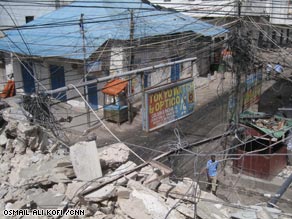
art.somalia.02.cnn.jpg

A man walks past the rubble of a building destroyed in Sunday's fighting

The two sides pounded each other with artillery, sending children scurrying and bringing business at the city's main market to a standstill.

"The fighting is so heavy and a barrage of mortar bombs is hitting many parts in Bakara market, killing people and causing heavy damages of buildings " said Ali Abdulkadir, a cloth trader at the city's main Bakara Market.

Hawo Abdi Oman, another eyewitness at the market, said a shell landed in an area crowded with people, killing nine civilians. Among the dead, she said, were two children and four women.

The market, a rebel stronghold, has been the site of numerous clashes since early last year.

In a nearby neighborhood, Geed Jaceyl, a shell landed on a house, crushing it. A woman who was inside was killed, witnesses said.

A second shell landed near a religious school, sending children running for cover. No one was injured in that incident.

The presence of Ethiopian troops trying to help defend a transitional government's hold on Mogadishu has united Islamic militant groups seeking to gain control of the city.

In 2006, the Islamic Courts Union -- a militia group -- ousted Somalia's transitional government from power. But the ICU was deposed in December of that year following Ethiopia's military invasion.

Since then, insurgent groups have been trying to destabilize the government.

Somalia's current transitional government is trying to maintain control of the capital, with the help of the better-equipped Ethiopian forces.

The violence has displaced more than 40,000 civilians who have taken shelter in dozens of makeshift settlements west of Mogadishu.

Somalia has been mired in chaos since 1991, when warlords overthrew dictator Mohamed Siad Barre and sparked brutal clan infighting.

Sunday's fighting came a day after suspected insurgents killed a local reporter, who freelanced for the BBC and Reuters news agency. The national union of journalists in Somalia called the death of Nasteh Dahir Farah a "targeted assassination."

He was the 10th reporter killed in the war-torn nation since last year.

Farah, 36, was gunned down on his way home from work in the southern city of Kismayu, according to the National Union of Somali Journalists.

-- Journalist Mohamed Amiin Adow contributed to this report

Tuesday, June 03, 2008

Ethiopia’s current ruler not any better than Mengistu


Publication Date: 6/2/2008
I refer to your question – “Where is justice?” – about the comfort the former Ethiopian dictator, Mengistu Haile Mariam, lives in Zimbabwe under the protection of another dictator Robert Mugabe (DN May 29, 2008).

The question would have been more pertinent had you just mentioned in passing, the abuses the current Prime Minister, Mr Meles Zenawi, metes out on his own countrymen.

Folks, have a look at this litany of docudrama-like piece of information that you decidedly left out in your editorial:

The Ogaden region, which is predominately inhabited by Somalis, is undergoing according to international NGOs, an operation aimed at torching villages and hanging sympathisers of the local rebel group, Ogaden Liberation Front.

Reports abound about villagers complaining about government troops killing young men, women, children.

During Ethiopia’s 2005 general elections, police killed about 193 protesters when the government-manipulated electoral commission declared victory for Mr Zenawi’s ruling party.

Opposition leaders, who claimed they had won the election outright, decided to stay away from their seats in parliament.

Mr Zenawi’s regime arrested more than 100 opposition politicians and charged them with treason.

They were only released when the international community pleaded for their release, after spending two years in jail.

Ethiopian troops are being killed in Somalia almost every day by landmines, fighting or by Somali insurgent snipers. Imagine how many more are being injured.

They could run into their hundreds.

If sending innocent soldiers into a sure fire killing field for no good reason is not a crime, what is a crime?

A large chunk of the country’s troops is fighting Eritrea, in a barren town called Badme.

Thousands of soldiers from both sides were killed in the 1998-2000 useless war. If that is not a crime what is?

Your editorial was really bereft of any comparison between the past, where Mengistu oppressed Ethiopians for opposing his rule, and the present, when a Western-backed Zenawi commits human atrocities against the same people who suffered under Mengistu and expected a change.

In 1991, when Mr Zenawi’s ragtag militias drove out Mengistu from the capital, Addis Ababa, Ethiopians were made to believe that a new era had dawned for them.

How wrong were they! About 17 years of Zenawi’s rule has produced no single free newspaper in Ethiopia and the opposition feels insecure as ever.

The past of Mengistu has almost caught up with the present of Zenawi!

Even, those in the know believe present abuses in Ethiopia

Justify Full

eclipse, in terms of intensity and brutality, those of Mengistu, who employed old styles of punishment, like mainly secretly assassinating opponents.

According to international NGOs, the government is starving residents in Ogaden, denies reporters access to the semi-arid region and shamefully claims that it is serving justice to Mengistu.

What a shame!

Only last month, Amnesty International accused the Ethiopian troops, backing Somalia’s titular government, of collective punishment against civilians.

It said the troops killed, gang-raped and gouged out eyes of Somalis in a report replete with chilling accounts of witnesses.

You reported that, but failed to mention it in your editorial.

DUCAYSANE M. MUHUMED,
Nairobi


Sunday, June 01, 2008

Three killed in Negelle Borena blast


A bomb has exploded in a hotel in southern Ethiopia, killing three people and wounding five others, information ministry spokesman Zemedkum Tekle says.

"According to some security reports, there has been an explosion in Negelle Borena today killing three people and injuring five. The government suspects a terrorist group planted a bomb in an hotel in Negelle Borena," he said on Wednesday.

"The government is making every effort to capture those responsible for this attack," he added.

Negelle Borena is a small town located about 600km south of the capital Addis Ababa, in the Oromo region, where rebels have fought for years over claims of marginalisation by the government.

The suspected bomb attack came as the regime of Ethiopian Prime Minister Meles Zenawi on Wednesday celebrated the 17th anniversary of former president Mengistu Haile Mariam's ouster.

On May 20, a bomb went off on a minibus near the foreign ministry in Addis Ababa, killing six people, including a US national.

The authorities, who made several arrests, blamed last week's explosion on arch-foe Eritrea and the Oromo Liberation Front (OLF).

Three people were also killed and 18 wounded in bomb blasts at petrol stations in Addis Ababa on April 14.

Oromo>> Appeal for UN general secretary Appeal for UN general secretary


Appeal for UN general secretary
The Wayane/TPLF Instigated Massacre of the Oromos in Western Oromia
May 28, 2008 - Once again the TPLF/ EPRDF regime has deliberately organized and instigated armed attack on the Oromo. This time the regime organized, trained, armed and unleashed militia from Gumuz, a nation in a region neighboring Oromia from the West, on wanton killings of the Oromos of East Wallaggaa, Western Oromia. This is a Crime against Humanity.

The Oromo and Gumuz peoples have lived together as good neighbors for hundreds of years. It is these neighboring peoples that the TPLF regime maliciously turned against each other causing days of violence that claimed the lives of more than 400 people, as a result of a campaign that went on from May 17, 2008 to May 19, 2008 . The Gumuz militia attack on the unarmed civilian Oromos caused the death of hundreds and many more injuries and displacement of hundreds to people, and destruction of large amount of properties. The TPLF regime trained and armed Gumuz militia with AK-47 and heavy machine-guns and ordered them to commit indiscriminate killings of unarmed Oromo civilians of East Wallagaa . As a matter of the TPLF government's policy, the Oromos were disarmed and are not allowed to bear arms. The Gumuz militia attacked the unaware and unarmed civilians. Hundreds of Oromos were subjected to horrific and barbaric killings. The militia is said to be so heavily armed that the local police themselves had to flee along with the civilians. The relevant government body and armed forces were bystanders watching the massacre of the unarmed and defenseless Oromos.

On May 17, 2008 , a significant number of well armed forces from the Benishangul Gumuz regional state suddenly attacked unprepared civilian Oromos early in the morning, before they were even awake from sleep. As the attackers were well armed with AK-47 and other unmentioned heavy machine guns, and were highly trained military personnel, they inflicted deadly massive casualties on the unawake Oromo civilians.

Conflicts have been reported in the following parts of East Wallagga . These are:
Saasiggaa District, particularly at Haroo Waataa, Camp 4, Camp 5, Camp 8,
and Baloo villages;
Limmu District, particularly at Arqumbee village; and Other areas
(clear location not found): Amba 7, and Mandar 10 villages. The conflict is still spreading to other areas in the region.
Digaa District, Arjoo Gudatu, and Dimtu area new war against the innocent unarmed Oromo people

2. Scope of the attacks which is stil going on

The invaders¢ actions include
mutilation of body parts (arms, legs, and
other organs of children, breasts of women, male genitals), throat cutting and slaughtering, burning down of housings and other properties, looting of properties including animals, raping of women and children, and burning of dead bodies in masses, to make access to information impossible. Very disturbingly, the invaders seriously target the male section of the society.
They also snatch infant babies from mothers¢ backs and kill, only to force the mothers to eat the flesh of their own babies.

Access to information has been intentionally made difficult, not only by the killers, but also by government structures. We are able to get information only for a limited part of the victim population (Saasiggaa district), and only for limited days of the incident (May 17-19, 2008). According to key informants and victim families, the names of which we don¢t have to disclose due security reasons, the following major causalities have resulted from the incident.

3. Consequences of the conflict

3.1 Lose of lives

A total of 400 Oromo civilians are estimated to be killed until May 19, in the areas mentioned above. About 65 of the dead are from Haroo Waataa village of Saasiggaa alone. Most of the dead are male children and the elderly. Only 115 dead bodies were found and buried in groups, in just four graves (40, 30, 25, 20 bodies). The remaining bodies, most of them burnt or eaten by dogs and hyenas, are being gradually discovered.

The following list provides the names of some of the dead, in Saasiggaa
district. The age and other identifications of the victims could not be found, for the moment.

a. Tasfaayee Qana¢aa
b. Waq-gaarii Deetii
c. Boggaalee Waaqtolee
d. Salbaanaa Galataa
e. Kabbadee Salbaanaa
f. Fiqaaduu Salbaanaa
g. Fayyisaa Wadaajoo
h. Tarrafaa Nagaraa
i. Badirii Jamaal
j. Samu¢el Waanee

3.2 Injuries

According to the key informant¢s observation, about 40 seriously injured
Oromo civilians were receiving medical treatment in Naqamtee Hospital as of May 19. Below is the list of only six of them, all of them from Haroo Waataa village:

A. Saamuu'el Tolasaa
B. Daanii'el Dhaabaa
C. Adam Muhaammad
D. Darajjee Fiqaaduu
E.. Addaamuu Imaanaa
F. Warkinesh Fiqaaduu
G. Abraham Mallasaa

3.3 Lose of properties

There is no quantified information about the extent of property lose resulted from the conflict. Generally, however, the properties of three villages in Saasiggaa, including Haroo Waataa and Baloo have been irrecoverably damaged: housings and in-house properties, including crops were totally burnt down; and the livestock were looted by the invaders. Similar types of loses of property have been reported elsewhere covered by the conflict.

3.4 Displacement

Civilians in the affected areas have continued to flee their homes and
properties beginning with the onset of the conflict on May 17, 2008. Until May 21, over 12, 0000 people are believed to have left their homes, and are camped in Naqamtee town and at a primary school in Saasiggaa district. According to a key informant, the Ethiopian Red Cross is providing minimum basic life-saving assistance to the victims.

4. Action taken by the government to stop the conflict

According to the Ethiopian Law, civilians are not allowed to bear arms in
general. Hence, Oromo civilians are totally unarmed. On the contrary, even ordinary Gumuz people are armed. The armed invaders used that opportunity as a source of arms supply for their continued killings. However, both the regional and the federal movements exhibited significant reluctance at stopping the conflict. Although the federal government has deployed its forces, they remained witness to the raging killings, instead of stopping the killers. They rather successfully prohibited Oromos from neighboring villages and local militias from coming to the rescue of the victims, and from and defending themselves. Most of the loses (both life and property) happened at the presence of the federal forces.

In further worsening of the situation, the government has systematically
blocked access to information through prohibiting access to victims and the damaged areas, by information seekers. Neither government media nor the free press has brought the issue to public attention.

5. The TPLF Regime only this year crime against the Oromo
Ever since it came to power, the TPLF/EPRDF regime has applied the outdated 'divide and rule' policy to weaken peoples' struggles for freedom and justice by sowing seeds of disharmony among friendly neighboring peoples. The TPLF regime's track record of the past 17 years of tyrannical rule is full of such evil intrigues that instigated bloody conflicts among peoples in Ethiopia . As a result of TPLF's machinations Oromo and Sidama, Oromo and Somali, Oromo and Gedao, Anywak and Nuer, Oromo and Amhara, Oromo and Oromo, now Oromo and Gumuz and several other people have clashed. As the result thousands of innocent lives were lost, tens of thousands of people were displaced and enormous amounts of properties were destroyed in the past 17 years. For example in this year only:-
1.With the TPLF, woyane regime instigated conflict between Guji Oromo and Konso 40 peoples have lost their life¢s, dozens wounded and properties were destroyed.
2.In the historic place of Madda Walabu many Oromo¢s have lost their lives.
3.In Me¢esso and many other places ,conspiracy was made between Oromo and Somalis , in which civilian Oromo¢s were murdered by the well armed groups.
4.In Wondo Genet more than 40 Oromo¢s were killed by raids.
5.TPLF have armed the Afar so as the can raid to the extent of Adama.
6.In Wanbara Oromo¢s are being hunted like a wild.
7.Many times and at different places in the Region of Benishangul TPLF have armed its murderers and raided the Oromo¢s in Limmuu ,Gigami, Manasibuu, Gidda, Sasigga ; which is followed in huge destruction. Accordingly as of may 17/2008 on civilian Oromo¢s are under armed attack by the same group.
8. The TPLF government is also active in refuge murder in the horn. In Somalia ; Punta land (Bosaso)65 were killed ,100 wounded and 250 homes burned down.
9.Ever year Oromo University students are killed and dismissed from school in group.
10. The government have the same plan in other part of Oromia in near future to create conflict between Oromo and Gambela (Anyuak) South, Isaa and Oromo in the East Oromiya
The most horrific act includes killing a mother and forcing the son to eat the deed body ,and they also killed the 2 week long mother giving birth and wounded the son.
Behind all the conflicts among peoples in Ethiopia during this period, there always are the TPLF regime's security agents deliberately creating distrust and suspicion among peoples who have lived peacefully for many years as neighbors. The regime survives by creating armed conflicts among peoples in Ethiopia . Such heinous act is a crime against humanity.

6. Annex

Last, but not least, we call upon the international community and governments to exert all necessary pressures on the TPLF regime to desist from its inhuman and destructive policies of deliberately setting the people it purports to govern against each other. We also call on all concerned governments and international organizations to pay close attention to the crime against humanity the minority tyrannical TPLF regime is perpetrating in Ethiopia and the Horn of Africa in general and take remedial actions before it is too late. We call European Union And USA government to stop all economic and material support for dictatorial regime.

A matter of life and death for brutal dictator

Story by KITSEPILE NYATHI, SUNDAY NATION Correspondent, HARARE
Publication Date: 2008/06/01

Zimbabwe’s presidential run-off election later this month must be giving exiled Ethiopian dictator, Mengistu Haile Mariam sleepless nights.

Mengistu Haile Mariam, the former Ethiopian leader who lives in exile in Zimbabwe. Photo/FILE
Despite being sentenced to death in absentia alongside a number of his former lieutenants by an Ethiopian court last week, Mengistu still lives like a king in impoverished Zimbabwe since he fled to Harare in 1991.

But his fate is closely tied to that of his ally President Robert Mugabe who goes to the June 27 election against his arch-rival, Morgan Tsvangirai of the opposition Movement for Democratic Change (MDC) with his back against the wall after an embarrassing first-round defeat in March.

The MDC, which already controls Zimbabwe’s parliament for the first time since independence, has vowed to hand Mengistu over to the Ethiopian authorities if it takes power. Mugabe‘s Zanu PF says it is indebted to the dictator for his role in the fight against colonialism.

Formal request

“He remains our guest in Zimbabwe. He will remain in Zimbabwe, and we will protect him as we’ve always done,” Deputy Information Minister, Bright Matonga said in response to the sentencing.

He said there had been no formal request regarding Mengistu from the Ethiopian government, but “even if they make the request, he’s not going anywhere.”

On the other hand, the MDC reiterated its 2006 stance following the dictator’s conviction on genocide charges that it would withdraw the protection afforded by Mugabe’s government.

“We don’t want dictators on our land,” MDC spokesman, Nelson Chamisa said.

“Of course we do not condone killing or the death sentence as MDC, but we want justice to be delivered to the victims and to the perpetrators so that there’s restoration.”

When the MDC nearly won the 2000 parliamentary elections and the 2002 presidential elections, Mengistu is said to have considered relocating to either China or North Korea.

Mengistu, a recluse and enigmatic figure in Zimbabwean politics since his arrival, is abhorred in the southern African country because of the feeling of many that he is one of the people advising Zanu PF on how to silence its critics through murder and torture.

Security adviser

In 2005, acting as Mugabe’s security adviser, he allegedly warned the Zimbabwean leader that the swelling slum population in the country was creating a fertile ground for a mass uprising.

He allegedly advised the Zimbabwean government to clear the slums in an operation that resulted in the death of several people and the displacement of more than 700 000 urban dwellers.

Mugabe’s government denied the accusations, but the accusation has stuck with Mengistu, and the opposition is not willing to forgive him.

Mengistu lives in luxury in one of the plush suburbs in the capital, Harare, with 24-hour security from the police VIP protection unit and the Central Intelligence Organisation (CIO) at Zimbabwean taxpayers’ expense.

He was also allocated two large farms, during Mugabe’s land seizure and is rumoured to own even more homes in Harare.

An activist campaigning for his extradition said that “he (Mengistu) drives at least six luxury cars, including a Mercedes Benz, a Toyota Prado, a Toyota Avensis, a BMW and a twin-cab truck.”

He also enjoys a special fuel scheme from the government-owned National Oil Company of Zimbabwe for personal use and for his farms, and his vehicles are serviced free of charge at the central mechanical equipment department, said the activist.

Since his arrival Mengistu’s life came under threat once when two Eritreans tried to assassinate him at his Harare residence.

The two were arrested and subsequently sentenced to 10 and five years imprisonment respectively.

Monday, May 26, 2008

Wayane is playing Game

ADDIS ABABA - Ethiopia has arrested suspects linked to last week’s bomb blast near the foreign ministry in Addis Ababa that killed six people, including a US national, state media reported yesterday.

Ethiopian police did not specify the number of arrests, but blamed the rebel Oromo Liberation Front (OLF) and its arch-foe Eritrea for last Tuesday’s blast in a minibus near the entrance to the foreign ministry. Seven people were injured.

"Some of the alleged terrorists that blew a minibus taxi with an explosive on May 20 in Addis Ababa were put under custody," Ethiopian News Agency quoted police and security officials as saying.

Evidence indicates "that the terrorist act was coordinated by the Eritrean regime and the anti-peace group ’Oromo Liberation Front’ which is an instrument of the regime," it added.

The US victim was believed to be a teacher at the University of Addis Ababa, from which the minibus had originally departed.

Three people were killed and 18 wounded in bomb blasts at petrol stations in Addis Ababa on April 14.

The authorities routinely accuse OLF, the rebel Ogaden National Liberation Front and Eritrea, for such attacks.


Sunday, May 25, 2008

America is reluctant to put Oromo Liberation Front, as terrorists

Ethiopia and the United States (from the Economist)

Economist


A loveless liaison

Apr 3rd 2008

map3.bmp

THE alliance between the United States and Ethiopia was born of pragmatism. In another time, they might have been enemies. Ethiopians do not like American soldiers tramping on their soil. Americans dislike Ethiopia’s bad human-rights record. Local elections due this month are a case in point. Ethiopia’s opposition, emasculated by the long imprisonment of its leaders (most of whom were pardoned last year) and weakened by its own divisions, will almost certainly be crushed in an unfair contest. “It’s going to be a stitch-up,” says a Western diplomat. “Control is what this government is all about.”

America jealously guards information about its more discreet military activities in Ethiopia, while advertising its soldiers’ do-gooding: digging wells, vaccinating animals and so on. Officially, it contributes only a sliver of Ethiopia’s $300m defence budget. Unofficially, it may have helped pay for the rising costs of Ethiopia’s army, one of Africa’s largest. Some say America has a secret base in eastern Ethiopia to move CIA, special forces and “friendlies” into next-door Somalia; America says not.

What is certain is that the closest military ties between the two countries involve Somalia, which America fears may have already become an incubator of Islamist terrorism. That is why America backed Ethiopia’s invasion of Somalia at the end of 2006. Its own air raids on supposed terrorist targets in Somalia have relied on Ethiopian intelligence, though nearly all appear to have missed. American officials praise the Ethiopian troops who are still in Mogadishu, Somalia’s battered capital, as peacekeepers; most Somalis see them as occupiers.

Leftist hardliners in Ethiopia’s government think that its prime minister, Meles Zenawi, is doing the Bush administration’s bidding. That is not how the Americans portray it. Regardless of Mr Zenawi, who must answer to his party’s central committee and is anyway due to step down in 2010, the Pentagon wants to make Ethiopia a bulwark in a region where Somalia is a dangerously failed state, Sudan and Eritrea are pariahs and Kenya has troubles of its own. Ethiopia has other selling points. The African Union is based there. Its ancient Christian history stirs American evangelicals. Its poverty and population (at 80m, Africa’s third-largest) attract development-minded foreigners.

But Ethiopia is too poor to be rated an A-list client state. Even American hawks admit that selling guns to one of the planet’s hungriest countries, the “cradle of humanity” to boot, would look bad. America says the little it gives Ethiopia’s forces is “non-lethal”: boots, night-vision goggles, medical kits and so forth. It would like to do more to train Ethiopian troops for peacekeeping work. A measure of America’s realism is the way it has allowed Ethiopia to buy arms from North Korea.

So differences remain. Many in Ethiopia’s 1.2m-strong diaspora in the United States have lobbied their congressional representatives to condemn Mr Zenawi’s government as tyrannical. A bill passed by the House of Representatives last year called for curbs on aid to Ethiopia, but is unlikely to be passed by the Senate. Yet it points to a division between those in Washington (mainly Republicans) wanting to reward Ethiopia for fighting terrorism in Somalia and those (mainly Democrats) wishing to punish it for its human-rights abuses at home.

Ethiopia, for its part, had hoped for stronger support from America over its border dispute with Eritrea. It wants the administration to list two Ethiopian separatist groups, the Ogaden National Liberation Front and the Oromo Liberation Front, as terrorists. America is reluctant. The process is complex; it has taken a long time to complete listing the Shabab, a Somali jihadist group. The Ogaden and Oromo fronts will go on fund-raising among their supporters in America, just as the Irish Republican Army once did.

Aid from European Union countries will probably keep flowing, however patent Ethiopia’s human-rights violations. China will invest more. But Ethiopia’s luck may run out. After several years of good harvests, a famine may set in this year. With 8m of its people likely to depend on food aid, much of it paid for by the Americans, Ethiopia still needs America a lot more than America needs it.

Saturday, May 24, 2008

Hundred killed during clashes between Gumuz and Oromos in Ethiopia


Ethnic clashes erupted in Ethiopia between the neighboring Gumuz and Oromo leaving hundreds killed and thousands displaced in Eastern Wellag of Oromia state.

The clash started on Saturday May 18, 2008, when armed Gumuz crossed over from their regional state to Oromia State and attacked villages before day break”, residents told Sudan Tribune.

Government officials have declined giving the official number of the victims of the conflict so far. Residents said that over 130 people died and about 8000 people have been internally displaced.

People died from both sides of the tribes but eyewitnesses have said, "the attacks were preplanned and nocturnal and the Oromos were caught unprepared ; as result, the majority of the people who lost their lives and whose houses were burned down with children inside were Oromos."

Oromos further accused the federal government of manipulating and arming the Gumuz to attack their neighboring Oromo over land claim.

The Oromo residents also suspect both the regional sate of Benishangul Gumuz and central government have role in arming and mobilizing the Gumuz to attack them.

Benishangul Gumuz state is located in the border with the eastern Sudan state of Blue Nile.

The federal police and Oromia regional police have not intervened to avert the armed attacks, residents claimed. They further say that the conflict is still going on and people are dying, houses and properties are being burned down daily.

For over a century, the two tribes share the same history of repression under successive Ethiopian regimes and lived together peacefully.

The Oromo are the largest single ethnic group in Ethiopia, at 32.1% of the population according to the 1994 census, and today numbering around 25 million.

They are divided into two major branches that break down into an assortment of clan families, however a number of ethnic based political organizations have been formed to promote the interests of the Oromo. Some of it seek to create an independent Oromo nation, some using armed force.

Giving a land that belongs to one group to the other to incite conflict has been seen in many neighboring Southern region since the current regime came to power in 1991. Land is also the cause of the conflict between the invading Sudanese Army in the Amhara region of Ethiopia.

Friday, May 23, 2008

Dictator accused international media and human rights groups

Dictator Meles confined his remarks to six scripted questions submitted by lawmakers. An attempt by one opposition politician to raise another point was overruled.

Dictator gave a detailed defense of the behavior of Woyanne troops supporting Somalia’s transitional government.

Several human rights groups have accused the soldiers of numerous atrocities during their nearly 18 months in Somalia, including an attack on a Mogadishu mosque last month that left at least 10 people dead.

In an e-mail to reporters Wednesday, a group called the Ogden Human Rights Committee also charged that civilians from Ethiopia’s Somali region are being forcibly repatriated, after fleeing to Somalia to escape a harsh Ethiopian counterinsurgency campaign.

Dictator Meles dismissed those reports as part of a smear campaign aimed at forcing the troops to leave Somalia. He vowed to keep them there as long as necessary.

“The international media and so-called human rights organizations do say all sorts of things about our military and ourselves with a tremendous smear campaign,” he said. “They do tarnish our reputation, but we will not be able to get rid of these tarnishing and smears because we leave Somalia. We should know those smears are not happening because those organizations don’t know the truth, but it’s because they choose to do so.”

The Ethiopian leader also addressed other regional issues, including a border dispute with Sudan, the recent incursion by Eritrean soldiers into Djibouti, and a water shortage in the capital.

But opposition politicians, diplomatic observers and journalists expressed surprise that several critical issues on the minds of Ethiopians went unmentioned. Among them are the recent spate of terrorist bombings in Addis Ababa, and a rapidly developing food emergency threatening the lives of tens of thousands of children?

The U.N. children’s agency UNICEF this week warned that as many as six million Ethiopian children are at risk of acute malnutrition, 126,000 of them in urgent need of therapeutic care to avoid starvation.

That word coincided with an announcement by the World Food Program that it is in danger of running out of emergency nutrition supplements, and word from the U.N. humanitarian agency OCHA that the number of Ethiopians in urgent need of food aid has increased by one million over the past month.

Dictator Meles’s comments in parliament came little more than 12 hours after a terrorist bomb destroyed a taxi minivan outside Ethiopia’s foreign ministry building, killing at least five people. Last month, bombs at two gas stations in Addis killed a total of three people.

No one has claimed responsibility for the bombing, but police attribute all three attacks and at least two other bomb blasts in the capital in recent month to terrorists.

In his comments to lawmakers Wednesday, Mr. Meles said several groups are ‘bent on causing havoc in our country’. He mentioned Horn of Africa rival Eritrea, as well as rebels of the Ogaden National Liberation Front and the regional Oromo Liberation Front

Dictator Meles Zenawi has accused international media and human rights groups of conducting a smear campaign against Woyanne troops in Somalia. Speaking to parliament, dictator Meles vowed that the troops would remain as long as needed to support the transitional government in Mogadishu. VOA’s Peter Heinlein listened to the dictators’s remarks and reports they were notable as much for what was not said as for what was.

Thursday, May 22, 2008

U.S. says own citizen killed in Ethiopian blast

WASHINGTON, May 21 (Reuters) - A U.S. citizen died in an explosion aboard a minibus taxi in Addis Ababa that Ethiopian police are blaming on extremists, the State Department said on Wednesday.

State Department spokesman Sean McCormack confirmed Tuesday's death but declined to provide the name of the victim or details because the person's family was still being notified.

"The embassy confirms one American citizen was killed in yesterday's minibus explosion. Apparently there was an explosion on a minibus that this person was on," said McCormack.

Asked whether foul play was suspected, McCormack said: "It sounds like there is something more than just a faulty gas line."

Police in the Ethiopian capital, Addis Ababa, said a device had been planted by "suspected terrorists" on the minibus as it was traveling between the Hilton hotel and the foreign ministry.

It was the latest in a string of explosions in Addis Ababa that Ethiopia has blamed on extremists backed by its neighbor and rival Eritrea. (Reporting by Arshad Mohammed; Writing by Sue Pleming; Editing by Xavier Briand)

Wednesday, May 21, 2008

Explosion rocks Ethiopian capital, three dead: police


ADDIS ABABA (Reuters) - An explosion on a minibus shook central Addis Ababa on Tuesday, killing three people and wounding nine, Ethiopian police said.

All the dead and wounded were on the bus, police said.

"Three people were killed and nine seriously injured by an explosion from a device planted by suspected terrorists inside a minibus taxi," said Addis Ababa police spokesman Densash Hailu.

The blast on a road between the Hilton hotel and the foreign ministry was the latest in a string of explosions in Addis Ababa that Ethiopia has blamed on extremists backed by its neighbor and rival Eritrea.

Scores of policemen and soldiers rushed to the scene, cordoning off the area as fire engines arrived.

Prime Minister Meles Zenawi's government routinely refers to the Eritrean government, with whom it fought a 1998-2000 border war, as terrorists.

Eritrea routinely denies the allegations, saying Meles faces an array of internal opponents.

A taxi driver who asked not to be named said he saw rescuers pulling out several dead people.

"I saw maybe 3 or 4 bodies taken away," the driver said.

Last month, Ethiopia blamed rebels backed by Eritrea when two bombs at petrol stations killed three people and wounded more than a dozen in the capital.

Eritrea and Ethiopia often trade accusations over their border dispute, in which some 70,000 died.

The two countries have been deadlocked over their 1,000 km (620-mile) frontier since a 2002 border ruling and analysts fear even small incidents could trigger renewed hostilities.

Earlier this year Eritrea obliged a U.N. peacekeeping force to quit the disputed border and on May 1 called on the Security Council to wind up the mission altogether.

The 1,700-strong force, known as UNMEE, had patrolled the border since 2000. It pulled out in February, saying Eritrea had cut off fuel supplies, and that most of its troops have returned to their countries of origin.

www.reuters.com